New review of the book “The Society of Singularities” by Andreas Reckwitz published in Organization Studies.
“Reckwitz offers a grand social theory of late modernity. His quest is to comprehend and conceptualize the social present. The gist of the book’s argument is that in modernity a societal structural transformation has occurred: the societal logic of the particular has taken precedence over the logic of the general. Reckwitz denotes the distinctive character, which is neither changeable nor comparable, as singularity. Both individuals and collectives, such as groups, organizations, or social movements, may seek exceptionalism. We curate and perform our lives and strive for authenticity, attraction, and positive valuation to generate short-term affective experience and long-term cultural value. This fits squarely with core organization studies concerns and arenas of attention of ‘organizations, organizing and the organized in and between societies’ and has the potential to shape organization theories’ depiction and prediction of social reality.” Unfortunately, wonderful comments by Andreas Reckwitz himself, Daniel Geiger and Oskar Piegsa had to be taken out during the review process. So I’d like to share them here:
Andreas Reckwitz: “The motive of my book was to clarify which consequences the reversal of a phenomenon at the margin into a dominant structure has in society. What happens if the orientation towards the singular, the extraordinary, the authentic – which in classical, industrial modernity was a side-phenomena – turns in late-modernity into a structure everything and everybody strives for and expects?”
Daniel Geiger: “For me this book is a perfect example to prove the analytical richness and explanatory power of a practice lens for studying organizations, the organized and societies. Reckwitz manages to connect the texture of different practices which cannot be studied in isolation – something that is often forgotten in recent practice-based studies. The idea of singularization and the valorization practices that are practiced in economics, culture, and life-stiles have a great potential to explain late modern societies. For me the book holds up a mirror to my own life. In a sense I would argue it is the new “Social Systems” (Luhmann, 1995) for the 21st century.”
Oskar Piegsa: “In Reckwitz I discovered quite a few theories that have been floating around in journalism and in the humanities in recent years. I found traces of David Brooks’ (2000) bourgeois bohemians and of Boltanski and Chiapello’s (1999) ‘Le nouvel Ésprit du Capitalisme’, to name only two. This is not to suggest his work is a meta-study or epigonal. ‘Singularities’ is highly original and its greatest purpose is in providing a grand theory that seems to explain a lot of what is happening today in culture and society. Where others described parts of contemporary culture, Reckwitz tackles the whole thing, all of it. However, I wonder if Reckwitz doesn’t overestimate the value of narrative, originality, and creative work. He argues that every college graduate today works in some way creatively, adding immaterial value to material things. I doubt that. And I’m afraid that categories such as ‘creative work’ or ‘cultural industries’ will lose their descriptive value if we apply them to, well, everything.”
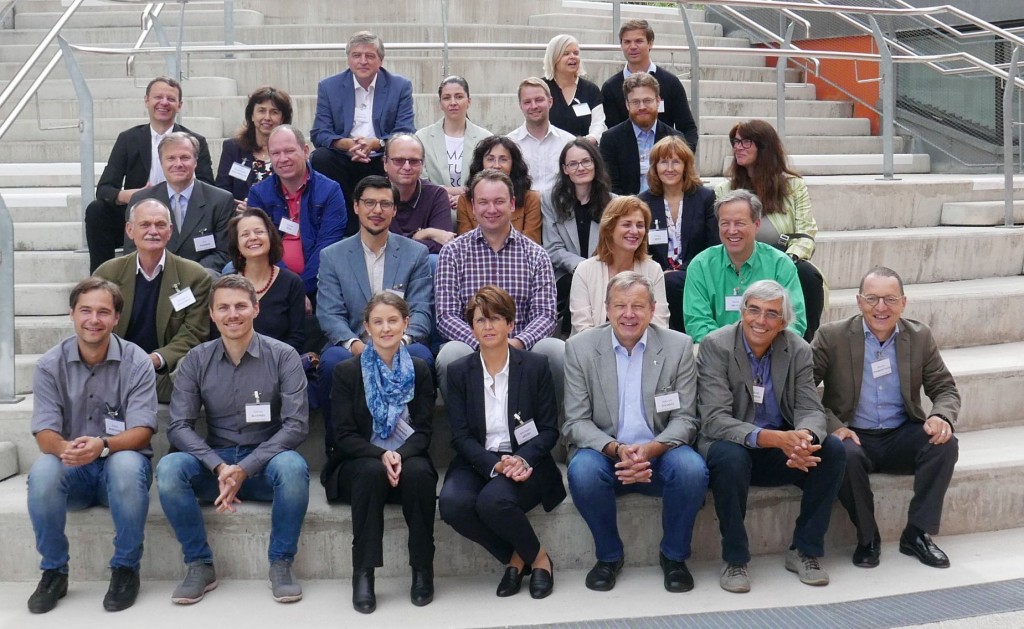
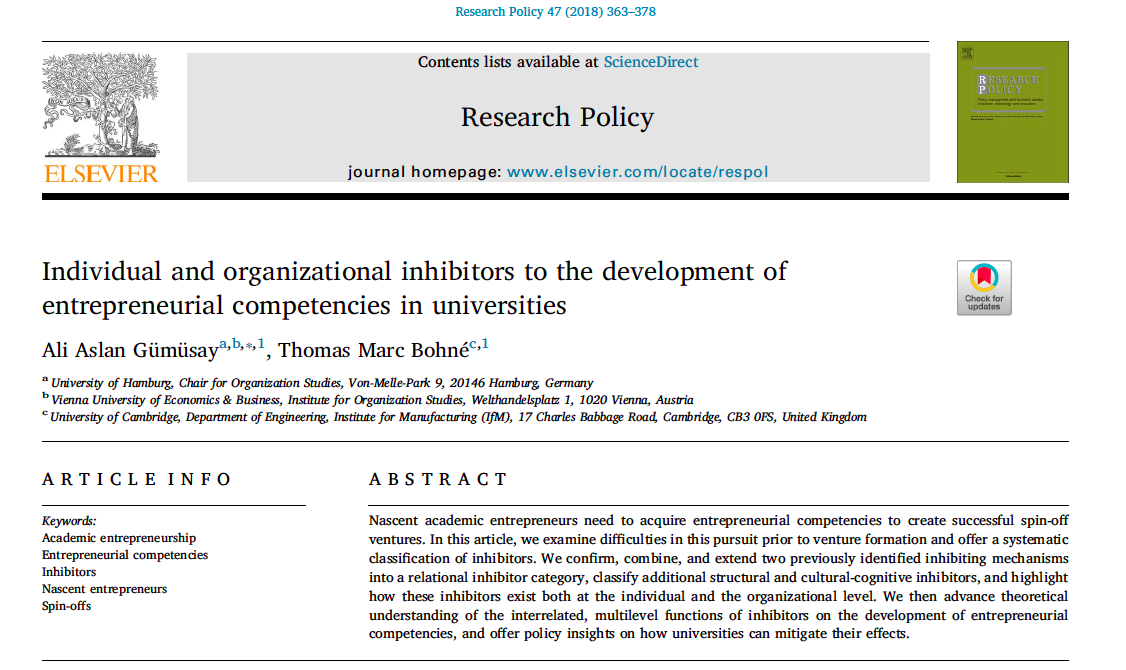
 funding for our scientific network. Over the next 3 years the network studies the relationship between societal grand challenges and new forms of organizing.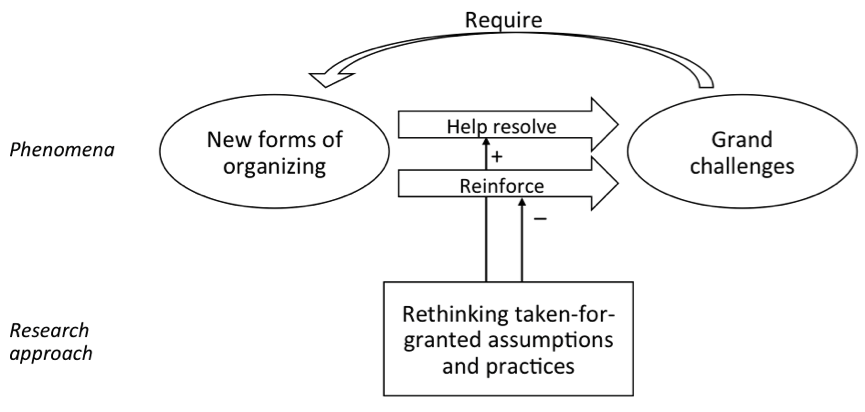
 societies that need to be integrated into theories of leadership. In this article, I outline how three distinct characteristics, particularly present in Abrahamic religions, can significantly impact leadership principles and practices: a belief in the existence of and relationship to a God, the faith in and pursuit of a hereafter purpose, and the belief in and attempted adherence to a sacred scripture. Subsequently, I classify two approaches to examine their impact on leadership: a scripture-based and an empirical-based lens. I then highlight how the distinct characteristics can either inform and blend into or transform and modify moral theories of leadership.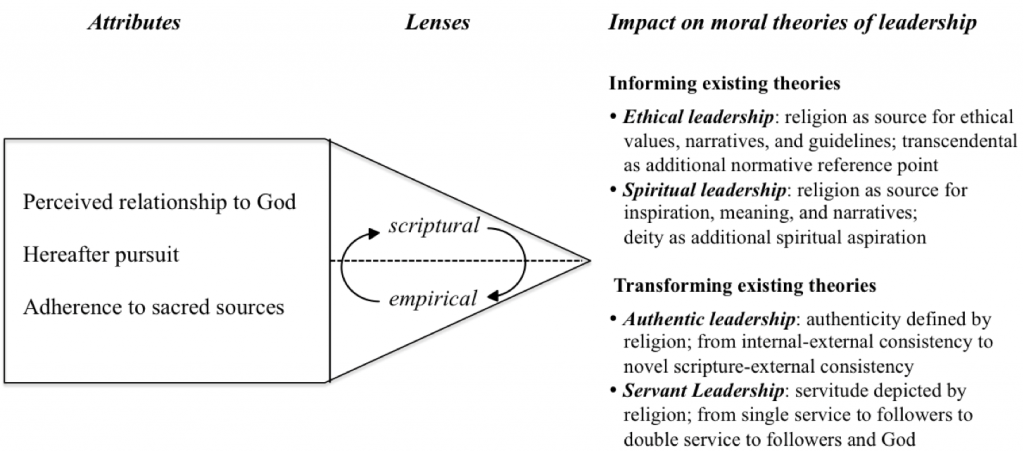
 relatively underexamined in organization theory. In this article, I assert that the institutional logics perspective is especially conducive to examine the macrolevel role of religion for organizations. The notion of the religious logic offers conceptual means to explain the significance of religion, its interrelationship with other institutional orders, and embeddedness into and impact across interinstitutional systems. I argue for intrainstitutional logic plurality and show that specifically the intrareligious logic plurality has been rather disregarded with a relative focus on Christianity and a geographical focus on “the West.” Next, I propose the concept of interinstitutional logic prevalence and show that the religious logic in particular may act as a metalogic due to its potential for uniqueness, ultimacy, and ubiquity. Through illustrations from Islamic Finance and Entrepreneurship, I exemplify implications of logic plurality and prevalence for organizations and societies.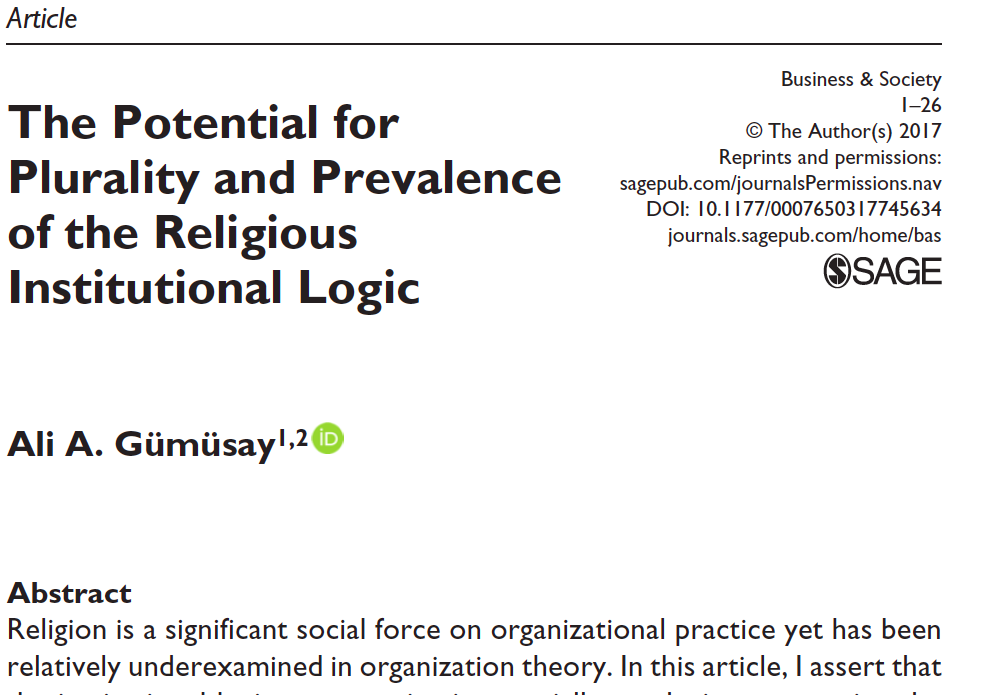
 weitestgehend ein Tabu. Über Religion redet man nicht. Man schweigt sich aus. Gleichzeitig werden Spiritualität, Meditation und Yoga salonfähig. Sie versuchen sich als mögliche Alternativen für Sinnstiftung und Orientierung in einer chaotischen und komplexen Welt. Doch das Thema Religion scheint nicht ausgestanden zu sein. Im Gegenteil: Es beherrscht den politischen Diskurs, spaltet Gesellschaften und Gemeinschaften, ist fast omnipräsent in den Medien. (…)